

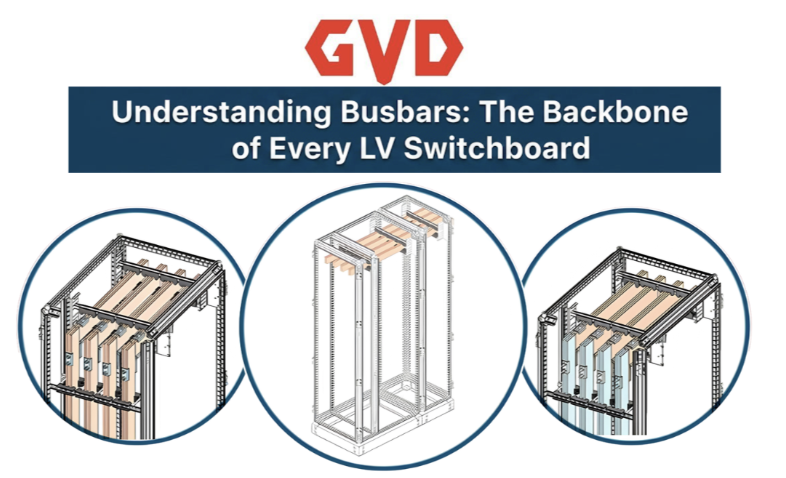
When discussing low-voltage (LV) switchboards, most people focus on circuit breakers, protection devices, or enclosures.
However, one essential component often receives less attention: the busbar system.
Busbars collect electrical power from incoming feeders and distribute it to outgoing circuits. Their design directly influences the safety, performance, and reliability of the entire switchboard.
Understanding how busbar systems work is essential for designing safe and efficient electrical distribution systems.
Why Are Busbar Systems Important?
Compared with conventional cable-based distribution, busbar systems offer several advantages.
They provide a compact arrangement, support high current ratings, and simplify power distribution within electrical switchboards.
Busbar systems can also improve accessibility for inspection and maintenance when properly designed.
For these reasons, they are widely used in:
- Industrial manufacturing facilities
- Commercial buildings
- Data centers
- Power generation and energy projects
- Infrastructure and EPC projects
In high-power applications, selecting the right busbar configuration is particularly important.
Why Does GVD Use Copper Busbars?
At GVD, we exclusively use copper busbars in our LV switchboard systems.
Copper offers excellent electrical conductivity and strong mechanical properties. It also delivers reliable performance under demanding operating conditions.
Another important advantage is its suitability for high short-circuit withstand applications when combined with properly designed supports and connections.
These characteristics make copper an effective material for high-performance electrical distribution systems.
There Is No Single Busbar Configuration for Every Project
A 630A switchboard and a 6300A switchboard cannot use the same busbar configuration.
Even two switchboards with identical rated currents may require different busbar arrangements.
Why?
Because busbar selection depends on several operating and design conditions:
- Ambient temperature around the switchboard
- Degree of protection (IP rating)
- Switchboard dimensions and depth
- ACB manufacturer, model, and frame size
- Short-circuit withstand requirements
Each factor influences the final design.
A Real Example from GVD
Consider a 6300A busbar system.
In a specific GVD configuration, the system can carry its full rated current at an ambient temperature of 25°C.
However, at 50°C with a protection degree higher than IP31, the permissible current decreases to 5800A.
This represents a reduction of approximately 8%.
Such a difference is not a minor technical detail.
It is an important design requirement that must be considered before manufacturing begins.
This example demonstrates why busbar design involves more than selecting copper bars.
Engineers must evaluate the complete operating environment and design the power distribution system accordingly.
How Does Busbar Arrangement Change with Current Rating?
As the required current increases, a single busbar may no longer provide sufficient capacity.
Multiple parallel bars can be used to distribute current and achieve the required thermal and mechanical performance.
At GVD, our busbar configurations follow a systematic approach based on the application.
Typical arrangements in specific GVD system configurations include:
- Up to 1600A: Two bars per phase, such as 2 × 60 × 10 mm
- Up to 2500A: Two larger bars per phase, such as 2 × 100 × 10 mm
- Up to 4000A: Four bars per phase, such as 4 × 100 × 10 mm
- Above 5000A: Double busbar arrangements using five to seven bars per phase
For certain systems above 5000A, GVD uses double busbar arrangements with a switchboard depth of 600 + 600 mm.
This configuration helps provide adequate space for current distribution, cooling, and mechanical support.
The final arrangement must always comply with the verified design requirements of the specific switchboard system.
Why Does ACB Brand Compatibility Matter?
One important aspect of busbar engineering is compatibility with air circuit breakers (ACBs).
Different ACB manufacturers use different terminal arrangements, connection geometries, and mounting dimensions.
At GVD, we provide connection kit solutions for several major ACB manufacturers:
- ABB
- Schneider Electric
- Siemens
- Eaton
- Legrand
The copper bar dimensions, connection geometry, and cover plate arrangements may differ depending on the manufacturer and ACB model.
Using an unsuitable connection kit can affect the electrical and mechanical integrity of the assembly.
Therefore, selecting the correct ACB connection kit is essential for safe and reliable operation.
Fixed vs. Drawout ACB: Does It Affect Busbar Design?
Yes.
The ACB installation type is another important consideration.
Fixed-type and drawout-type ACBs may require different connection kits, mounting arrangements, and cover plates.
A drawout ACB uses a withdrawable mechanism that allows the circuit breaker to be moved between its designated operating positions.
A fixed ACB, on the other hand, is installed in a stationary configuration.
These differences affect how the busbar system connects to the circuit breaker.
Consequently, the connection design must match both the ACB model and its installation type.
Small Design Details Make a Big Difference
Busbar engineering also depends on the internal dimensions of the switchboard.
In GVD’s relevant system configurations, busbar arrangements are designed around a standard panel depth of 600 mm.
For panel depths of 800 mm and above, vertical busbar separators may be required according to the system design.
These components support the intended internal segregation and mechanical arrangement.
Short-Circuit Reinforcement
High short-circuit currents generate significant electrodynamic forces.
These forces can place considerable mechanical stress on busbars, connections, and support structures.
For applications requiring short-circuit withstand levels from 75 kA up to 120 kA, additional stabilizer units can be incorporated into suitable GVD connection kit designs.
These reinforcements help improve the mechanical strength of the busbar assembly.
Although such components may appear relatively small, they play an important role in the overall performance of the switchboard.
Vertical Busbars: A Different Distribution Arrangement
Vertical busbar systems are commonly used to distribute electrical power between different functional units or compartments.
Their mechanical arrangement differs from that of horizontal main busbars.
GVD also provides vertical busbar solutions for applications up to 3200A.
These systems require appropriately designed internal support structures.
The number and positioning of support points depend on several factors, including:
- Busbar cross-section
- Rated current
- Short-circuit withstand level
- Internal switchboard configuration
For the relevant GVD configurations above 3200A, a minimum compartment width of 300 mm is required.
As with horizontal busbars, the final design must be evaluated as part of the complete switchboard assembly.
IEC 61439 and Busbar System Verification
Busbar systems are an essential part of the design verification process for low-voltage switchgear and controlgear assemblies.
The IEC 61439-1 and IEC 61439-2 standards establish requirements for the design and verification of these assemblies.
Relevant considerations include:
- Temperature-rise limits
- Short-circuit withstand strength
- Dielectric properties
- Clearances and creepage distances
- Protective circuit integrity
- Mechanical and electrical connections
Compliance cannot be established by evaluating the copper bars alone.
The complete switchboard assembly must meet the applicable verification requirements.
GVD’s Engineering Approach to Busbar Systems
At GVD, we do not treat busbars as isolated components.
We design them as an integral part of the entire LV switchboard system.
From the earliest design stages, our engineering approach considers current ratings, ambient temperature, IP protection, ACB compatibility, switchboard dimensions, and short-circuit withstand requirements.
Because a reliable LV switchboard is not defined only by the quality of its components. It is defined by how effectively those components are engineered to work together.
Would you like to learn more about GVD’s LV switchboard systems or discuss the technical requirements of your next project?
Our team would be pleased to assist you.
Contact GVD
Email: export@gvd.com.tr
Website: www.gvd.com.tr
Frequently Asked Questions About Busbar Systems
1. What is a busbar system in an electrical switchboard?
A busbar system is a set of electrical conductors used to distribute power within a switchboard. It transfers electricity from incoming feeders to outgoing circuits. Proper busbar design helps ensure safe current distribution, thermal performance, and short-circuit withstand capability.
2. What is the difference between copper and aluminum busbars?
Copper offers higher electrical conductivity than aluminum and generally requires a smaller conductor cross-section for the same current-carrying capacity. Aluminum is lighter and can be more economical.
GVD exclusively uses copper busbars in its LV switchboard systems to support high-performance and reliable electrical distribution.
3. How are busbar size and the number of bars determined?
Busbar dimensions and the number of parallel bars depend on rated current, ambient temperature, IP protection, switchboard dimensions, cooling conditions, and short-circuit withstand requirements.
For example, certain GVD configurations use two bars per phase at 1600A and four bars per phase at 4000A.
The final selection must follow the verified system design.
4. Does ambient temperature affect busbar current-carrying capacity?
Yes. Higher ambient temperatures can reduce the permissible current-carrying capacity of a busbar system.
For example, a specific GVD 6300A configuration can be derated to 5800A at 50°C with an IP rating above IP31.
This is why temperature conditions must be considered during switchboard design.
5. How does the IP rating affect busbar performance?
The IP rating indicates the degree of protection provided by an enclosure against solid objects and water ingress.
Higher IP protection levels can restrict natural ventilation and influence internal temperature rise.
Therefore, busbar selection must consider the verified thermal performance of the complete switchboard, particularly in enclosed systems such as IP54, IP55, and IP65.
6. Why is short-circuit withstand important for busbar systems?
During a short circuit, busbars experience significant thermal and electrodynamic stresses.
The conductors, connections, and supporting structures must withstand these conditions without unacceptable damage.
GVD offers suitable mechanical reinforcement solutions for specific system configurations with short-circuit withstand requirements ranging from 75 kA to 120 kA.
7. Can the same busbar connection kit be used for different ACB brands?
Not necessarily.
ACB manufacturers such as ABB, Schneider Electric, Siemens, Eaton, and Legrand may use different terminal dimensions, connection geometries, and mounting arrangements.
Therefore, busbar connection kits must be selected according to the ACB manufacturer, model, rated current, and installation type.
GVD provides dedicated connection kit solutions for different ACB brands and models, supporting electrical and mechanical compatibility within the switchboard system.
8. Are busbar connections different for fixed and drawout ACBs?
Yes. Fixed and drawout ACBs can have different connection geometries and installation requirements.
Consequently, they may require different busbar connection kits, mounting arrangements, and cover plates.
The correct configuration must be selected according to the circuit breaker model and installation type.
9. Why are double busbar systems used above 5000A?
High-current applications may require multiple parallel busbars to achieve the necessary current-carrying capacity and thermal performance.
In certain GVD configurations above 5000A, double busbar arrangements are used with a switchboard depth of 600 + 600 mm.
This arrangement provides additional space for the required connections, cooling, and mechanical support.
10. Which standards apply to LV switchboard busbar systems?
IEC 61439-1 and IEC 61439-2 are the primary standards applicable to low-voltage switchgear and controlgear assemblies.
They include requirements for temperature rise, short-circuit withstand, dielectric properties, protective circuit integrity, and design verification.
Busbar compliance must be evaluated as part of the complete switchboard assembly.
11. What is the difference between horizontal and vertical busbars?
Horizontal busbars generally distribute main electrical power across switchboard sections.
Vertical busbars distribute power to functional units or outgoing circuits within a section.
Their arrangement, support structure, and short-circuit withstand requirements may differ depending on the application.
12. Can two switchboards with the same rated current use different busbar configurations?
Yes.
Two switchboards with identical rated currents may have different ambient temperatures, IP protection levels, dimensions, ACB models, and short-circuit withstand requirements.
Therefore, the same rated current does not necessarily mean that the same busbar dimensions or arrangements can be used.
Correct busbar selection depends on the complete operating conditions and verified switchboard design.