

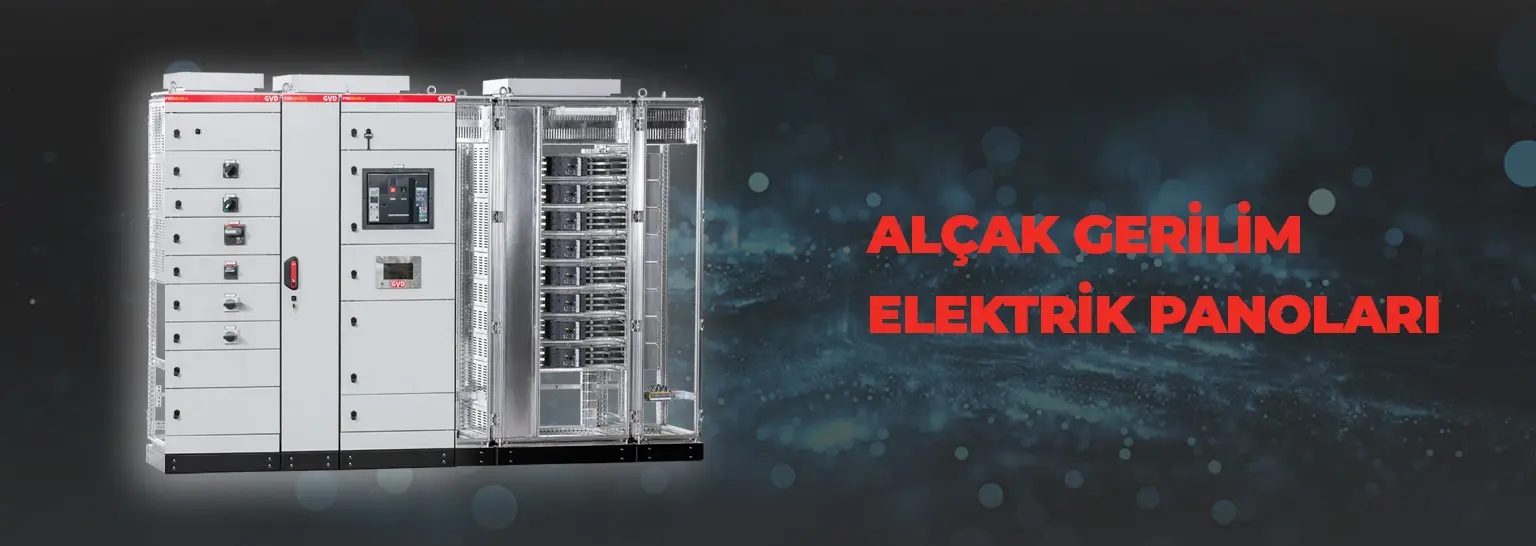
Low-Voltage Electrical Panel Manufacturing in Turkey: GVD Group’s Engineering-Focused Solutions
Turkey is a strategic market where the demand for low-voltage electrical panels is rising alongside rapid growth in the industrial, energy, infrastructure, and manufacturing sectors. While the sector features strong manufacturers serving both local and international projects, GVD Group stands out as a key player thanks to its engineering quality, type-tested systems, international certifications, and global reference network.
GVD Group is not merely a panel manufacturing facility; it is an engineering company that develops high-performance, durable low-voltage panel systems compliant with IEC 61439-1/2 standards. Its extensive product range—spanning from the Premium-X series to WMCC solutions—is more comprehensive than that of most other manufacturers in Turkey.
Low-Voltage Electrical Panels Manufactured by GVD
MCC (Motor Control Center) Panels
- Withdrawable / Fixed type
- High short-circuit withstand capacity
- Designed for industrial facilities, cement plants, mines, and refineries
- Rapid maintenance, easy module replacement, maximum safety
PCC (Power Control Center) Panels
- High efficiency in energy management
- Ideal for facilities requiring uninterrupted power
- Thermal power plants, production lines, water treatment facilities
MPCC (Main Power Control Center)
- Used in the main distribution centers of facilities
- Suitable for high current and short-circuit levels
- Maximum safety with GVD’s Premium-X enclosure system
Premium-X & Premium-XW Modular Panel Systems
- IEC 61439 type-tested
- Modular and flexible structure
- GVD quality, preferred for global projects
Compensation, Automation, and Custom-Designed Panels
- Project-specific engineering
- Industrial automation, SCADA integration
- High efficiency and energy optimization
Why Is GVD One of Turkey’s Strongest LV Panel Manufacturers?
IEC 61439-1/2 Type-Tested Systems
Few panel manufacturers in Turkey meet this standard. GVD’s entire critical product range is designed and certified in compliance with this standard.
Exports to 60+ Countries Across 4 Continents
Africa, the Middle East, Europe, Asia…
GVD is one of Turkey’s strongest representatives in the field of international low-voltage panel manufacturing.
Engineering-Driven Design
- 3D modeling
- Thermal analysis
- Short-circuit calculations
- Selectivity analyses
All performed by in-house engineers.
High-Quality Sheet Metal Processing and Painting Technology
Long-lasting, durable, and aesthetic solutions.
Major Project References
- Power plants
- Refineries
- Metro/infrastructure projects
- Factories
- Water treatment plants
- Solar power plants
Few domestic manufacturers possess references of this scale.
Sıkça Sorulan Sorular
An LV (Low Voltage) panel is an integrated electrical system used for the distribution, protection, control, and monitoring of electrical energy. While distributing energy to the facility's various lines, it simultaneously ensures safety (via protection components) and operational continuity.
MCC panels are designed for the control, protection, and operation (via contactors, soft starters, drives, etc.) of motors. They are preferred for motor-intensive production lines in cement plants, mines, refineries, and industrial facilities.
In withdrawable systems, maintenance time is reduced and downtime minimized because modules can be inserted and removed like drawers. Fixed-type systems may have a simpler structure; however, maintenance and refurbishment processes generally require more planning.
PCC panels are positioned for plant-wide power distribution and energy management; they are used for larger power supplies and distribution scenarios. While MCCs focus on motor control, PCCs are designed primarily for main power distribution and ensuring the continuity of critical lines.
The MPCC can be considered the facility's main distribution center. It is located at the main busbar or main distribution point—where high current levels and short-circuit withstand capability are required—and supplies downstream panels.
IEC 61439-1/2 defines the design verification, safety, and performance requirements for low-voltage switchgear and controlgear assemblies. Compliance with this standard is a key criterion regarding reliability, documentation quality, and project acceptance processes.
A type-tested (design-verified) panel refers to a panel in which critical criteria—such as thermal performance, short-circuit withstand capability, and protection levels—have been verified through specific tests or analyses. This approach is preferred, particularly in critical infrastructure projects.
Key criteria include short-circuit withstand capability, IP/IK protection ratings, thermal performance, selectivity, modularity, ease of maintenance, continuity of spare parts and service, and documentation compliant with standards. The facility's operating conditions (dust, humidity, temperature) must be taken into account.
Short-circuit calculations are performed to verify the mechanical and thermal withstand capability of the panel against high currents that may arise during potential faults. Accurate calculation and coordination directly impact safety and equipment lifespan.
Thermal analysis mitigates the risk of overheating by evaluating the heat distribution generated by the panel during operation. This aims to ensure more stable equipment performance and extend the system's lifespan.
Selectivity analysis aims to prevent unnecessary power outages by ensuring that only the relevant line trips in the event of a fault. This is a crucial design criterion, particularly for facilities where production continuity is critical.
Modular systems facilitate rapid adaptation to the project, scalability, and ease of installation and maintenance through their standardized housing structure. They also offer configuration flexibility to meet diverse project requirements.
Power factor correction panels support energy efficiency by managing reactive power. Panels with automation/SCADA integration, meanwhile, ensure operational efficiency and process management through monitoring and control capabilities.
Sheet metal quality, machining precision, and painting/corrosion protection processes directly affect the enclosure's mechanical strength, longevity, and aesthetics. These processes are decisive for reliable performance under demanding industrial conditions.
Safe and sustainable panel solutions based on the IEC 61439 verification approach.
Provide your single-line diagram, load list, and site conditions, and let us prepare a comprehensive proposal that includes design verification, selectivity, and thermal assessment.
contact us
- Atatürk Mah. Metropol İstanbul A Blok Kat: 21 No: 331 Ataşehir / İstanbul / Türkiye
- +90 216 455 15 50
- gvd@gvd.com.tr
Copyright © 2026 GVD Group. All rights reserved.